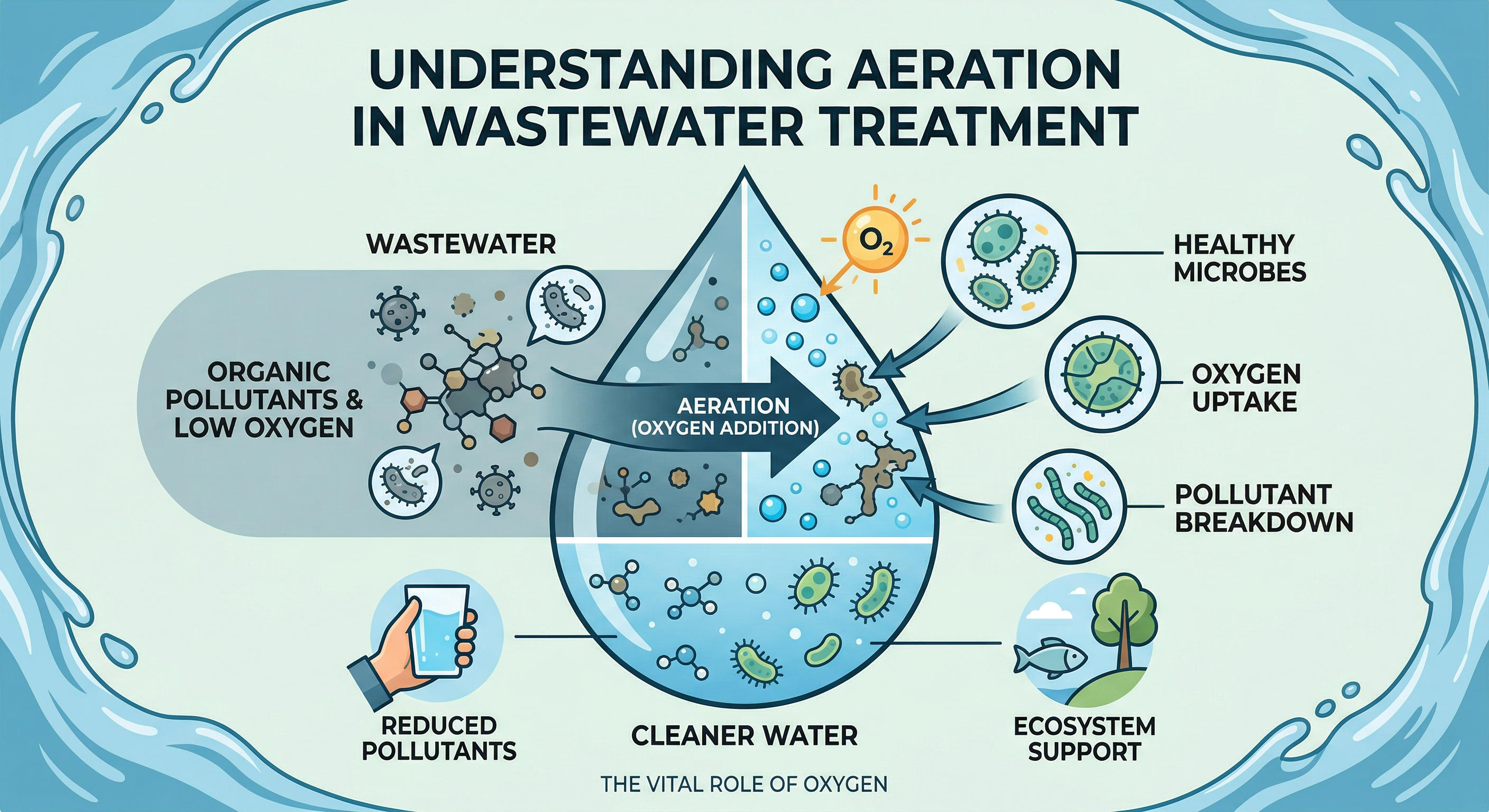
Aeration in wastewater treatment is the process of introducing air or oxygen into wastewater to support aerobic microorganisms that break down organic pollutants and improve water quality.
Aeration in wastewater treatment is a fundamental process used in both Sewage Treatment Plants (STP) and Effluent Treatment Plants (ETP) to improve water quality by supplying oxygen.
It supports the growth of aerobic microorganisms that break down organic pollutants, reduce Biochemical Oxygen Demand (BOD), and help treated water meet environmental discharge standards.
In modern wastewater engineering, aeration is not just about adding air; it is a controlled and energy-intensive process that directly impacts treatment efficiency, operational cost, and regulatory compliance.
What Is Aeration in Wastewater Treatment?
Aeration is the process of introducing air or oxygen into wastewater to promote the biological degradation of organic matter by aerobic microorganisms.
These microorganisms use oxygen to convert pollutants into:
- Carbon dioxide (CO₂)
- Water (H₂O)
- Biomass (sludge)
In the absence of aeration, wastewater becomes septic, which can lead to:
- Foul odours (such as hydrogen sulphide)
- Reduced treatment efficiency
- Non-compliance with discharge standards
Why Is Aeration Important in STP and ETP?
Aeration plays a critical role in wastewater treatment systems:
1. Enables Biological Treatment
Aerobic bacteria require oxygen to efficiently degrade organic pollutants.
2. Reduces BOD and COD
Aeration accelerates the oxidation of organic matter, thereby reducing the pollution load.
3. Prevents Anaerobic Conditions
It helps avoid the formation of undesirable gases such as methane (CH₄) and hydrogen sulphide (H₂S).
4. Supports Nitrification
Aeration enables the conversion of toxic ammonia into nitrate, which is comparatively less harmful.
5. Provides Effective Mixing
It ensures uniform contact between microorganisms, oxygen, and wastewater, improving overall treatment performance.
How Does Aeration Work?
The aeration process typically involves the following steps:
- Air is introduced into wastewater using aerators or diffusers
- Oxygen dissolves into the liquid phase
- Microorganisms consume organic pollutants using the dissolved oxygen
- Pollutants are converted into stable end products
- Biomass formed during the process settles during secondary clarification
This process is commonly applied in:
- Activated sludge systems
- Sequencing Batch Reactors (SBR)
- Aeration tanks
Biological Role of Aeration
Aeration supports two key biological processes:
- Carbonaceous Oxidation (BOD Removal)
Microorganisms oxidise organic carbon into carbon dioxide and water.
- Nitrification (Ammonia Removal)
NH3+2O2→NO3−+2H++H2ONH_3 + 2O_2 \rightarrow NO_3^- + 2H^+ + H_2ONH3+2O2→NO3−+2H++H2O
This reaction indicates that ammonia requires oxygen for conversion into nitrate.
Approximately 4.57 mg of oxygen is required per mg of ammonia, which makes aeration a highly energy-intensive process.
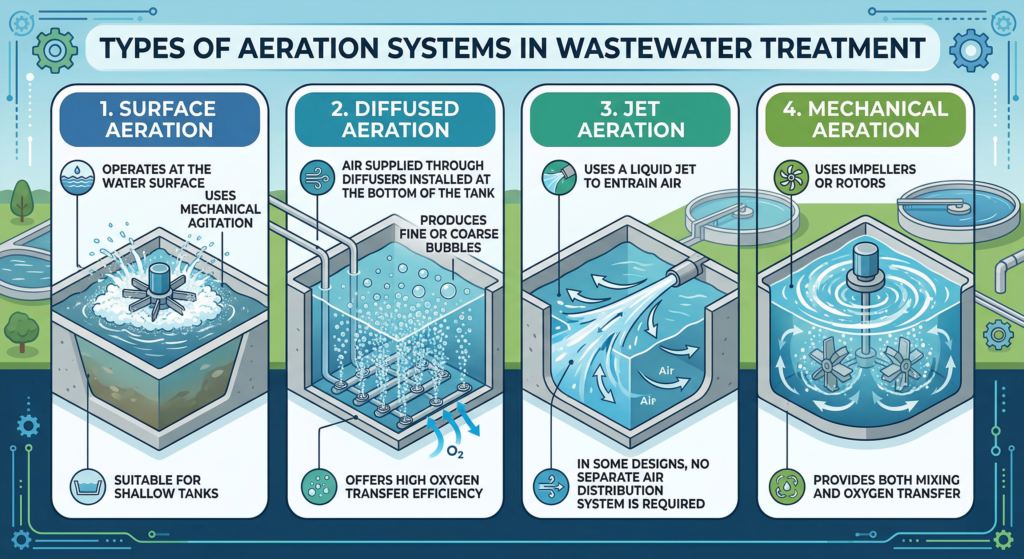
1. Surface Aeration
- Operates at the water surface
- Uses mechanical agitation
- Suitable for shallow tanks
2. Diffused Aeration
- Air is supplied through diffusers installed at the bottom of the tank
- Produces fine or coarse bubbles
- Offers high oxygen transfer efficiency
- Uses a liquid jet to entrain air
- In some designs, no separate air distribution system is required
4. Mechanical Aeration
- Uses impellers or rotors
- Provides both mixing and oxygen transfer
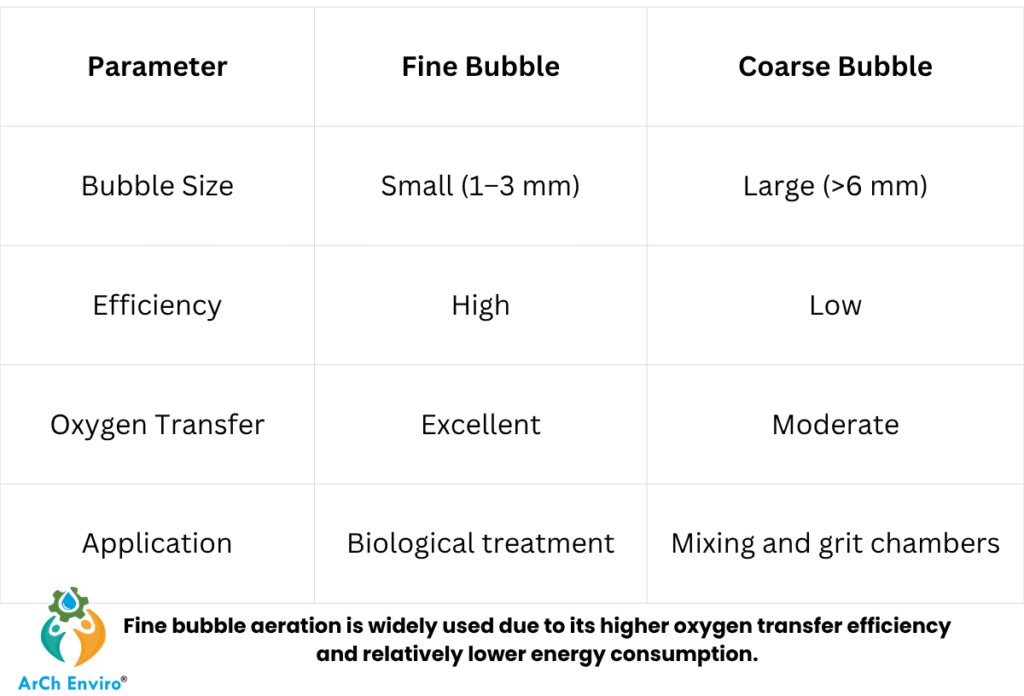
Fine Bubble vs Coarse Bubble Aeration
Key Factors Affecting Aeration Efficiency
Aeration performance depends on several parameters:
- Oxygen Transfer Rate (OTR)
- Dissolved Oxygen (DO) levels
- Bubble size and distribution
- Tank depth
- Wastewater characteristics
- Temperature and pH
Alpha Factor (α): Represents the reduction in oxygen transfer efficiency in actual wastewater compared to clean water.
Beta Factor (β): Accounts for variations in oxygen solubility due to dissolved solids.
Energy Consumption in Aeration Systems
Aeration is typically the most energy-intensive process in a wastewater treatment plant.
- It can account for approximately 50–70% of total energy consumption
- It significantly influences overall operational costs
Optimizing aeration systems can lead to:
- Reduced power consumption
- Lower operating costs
- Improved sustainability
Modern Aeration Control and Automation
Advanced wastewater treatment systems use:
- Dissolved Oxygen (DO) Sensors
To maintain optimal oxygen levels in real time.
- ORP (Oxidation-Reduction Potential) Monitoring
To identify aerobic, anoxic, and anaerobic conditions.
- Variable Frequency Drives (VFDs)
To regulate blower speed based on process demand.
- Ammonia-Based Aeration Control (ABAC)
To optimise oxygen supply based on ammonia concentration.
Challenges in Aeration Systems
Common operational challenges include:
- High energy consumption
- Diffuser clogging and fouling
- Uneven air distribution
- Equipment wear and maintenance issues
- Sludge bulking due to inadequate aeration
Regular monitoring and maintenance are essential to ensure consistent system performance.
Future Innovations in Aeration Technology
Recent advancements in aeration include:
1. Membrane Aerated Biofilm Reactors (MABR)
- Supply oxygen through membranes
- Can significantly reduce energy consumption
2. Aerobic Granular Sludge (AGS)
- Provides faster settling characteristics
- Reduces plant footprint
3. AI-Based Aeration Control
- Enables predictive process optimisation
- Helps minimise energy usage
Environmental Impact of Aeration
Although aeration is essential, it also contributes to:
- High energy consumption
- Greenhouse gas emissions (such as CO₂ and N₂O)
Efficient aeration design and control can help:
- Reduce emissions
- Improve environmental performance
- Support regulatory compliance
What Happens Without Aeration?
- Anaerobic conditions develop
- Bad odour (H₂S gas)
- Poor treatment efficiency
- Sludge bulking
Conclusion
Aeration is a critical process in wastewater treatment that enables the effective removal of organic pollutants and nutrients.
By supporting microbial activity and facilitating biological processes such as oxidation and nitrification, aeration directly influences treatment efficiency and compliance with environmental standards.
With advancements in aeration technology and process control, modern systems are becoming more energy-efficient and sustainable, making aeration a key component of effective wastewater management.
Frequently Asked Questions (FAQs)
- What is aeration in wastewater treatment?
Aeration is the process of introducing air or oxygen into wastewater to support aerobic microorganisms that break down organic pollutants and improve water quality.
- Why is aeration important in STP and ETP?
Aeration is essential for biological treatment, reduction of BOD and COD, prevention of odour, and conversion of ammonia into less harmful compounds.
- What are the types of aeration systems?
The main types of aeration systems include surface aeration, diffused aeration (fine and coarse bubble), jet aeration, and mechanical aeration.